Overview
Unify is a learning and events platform that helps newcomers to Canada find their footing
Finances, jobs, housing, healthcare, and essential documents — the building blocks Unify brings together to help newcomers settle into life in Canada, step by step, through lessons and local events.
Problem
Settling in Canada is harder than it should be
For newcomers, settling in Canada means rebuilding a life from scratch, often while navigating fragmented information and disconnected support systems.
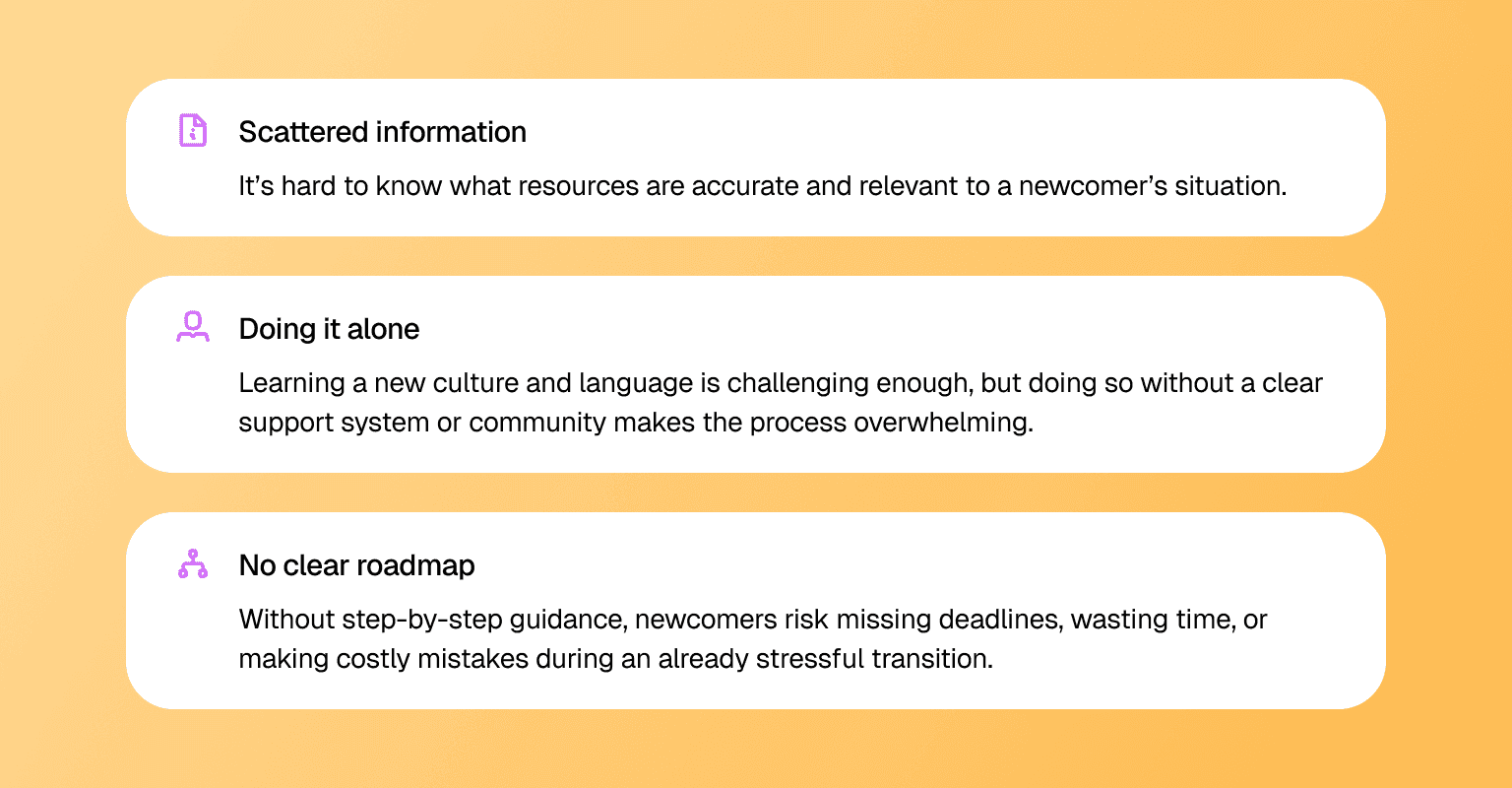
These challenges are most intense in the first few months, when newcomers experience cognitive overload and must complete multiple time-sensitive tasks at once. This creates an opportunity for Unify to act as a central home base, organizing essential knowledge and events so newcomers can settle with clarity and confidence.
Opportunity
Own the settlement journey, not just the information
Newcomers aren't lacking information — they're lacking structure. During the most time-sensitive months of settlement, critical knowledge and support are fragmented across disconnected sources.
Unify can own the settlement journey by organizing essential knowledge and events into a clear, continuous experience.
Guidance
Turn scattered resources into a clear, prioritized path that guides newcomers.
Continuity
Support progress over time by helping users resume learning and track where they left off.
Connection
Link learning to real-world events so users can act on information, not just read it.
Solution
Unify: a guided settlement journey, made simple
Unify helps newcomers navigate their first months in Canada with clarity and confidence. Focused lessons provide structured guidance, while timely local events turn learning into action, reducing overwhelm and supporting progress over time.
Core Flows
Continue your learning path
Pick up where you left off and stay focused on what matters most next.
Choose a focused topic
Browse structured topics within each subject to learn one essential system at a time.
Learn at your own pace
Read clear, step-by-step lessons designed for newcomers with no prior context.
Quick check, no pressure
Optionally review key ideas to reinforce understanding before moving on.
Turn learning into action
Register for local events and workshops to apply what you've learned and connect with others.
Research
Researching the settlement journey in Canada
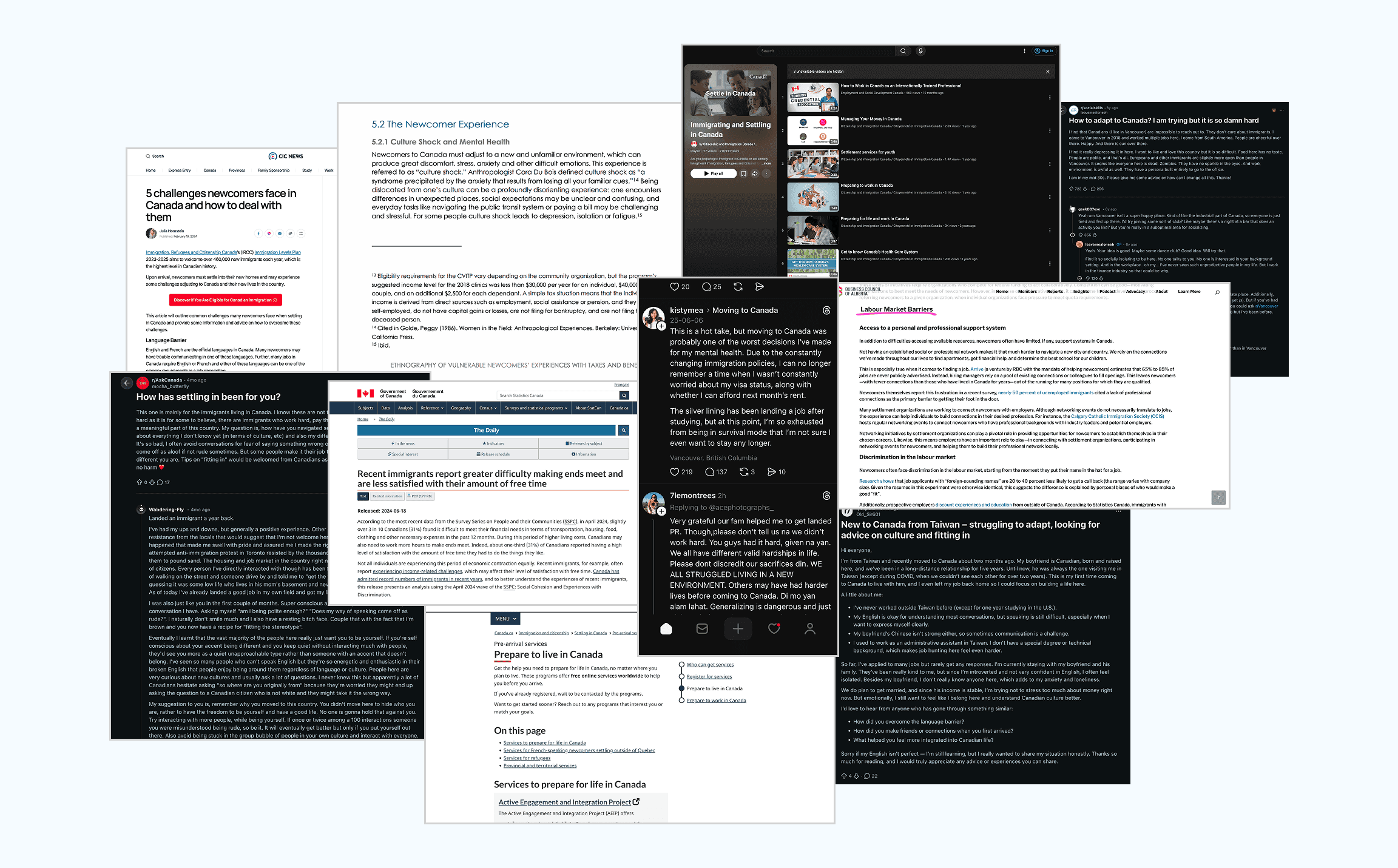
To understand where newcomers struggle most during their first months in Canada, we analyzed how settlement tasks are experienced over time. Using a mix of secondary research, online community discussions, and interviews, we identified recurring patterns in how newcomers seek information, prioritize tasks, and look for support.
Our research focused less on individual tasks and more on when guidance is needed and how it can reduce overwhelm during an already complex transition.
Strategic Focus Areas
Primary users
Newcomers in their first few months in Canada, when unfamiliar systems and time-sensitive tasks overlap.
Key settlement topics
Finance, employment, housing, documentation, healthcare, and Canadian culture emerged as the most critical areas for early support.
Community support
Newcomers rely on informal communities for validation and advice, highlighting how human connection builds confidence.
Key Insights
1. Uncertainty, not information, is the core challenge
Newcomers are often overwhelmed by not knowing what to do next, even when information is technically available.
2. Early settlement tasks overlap and compete for attention
During the first few months, multiple time-sensitive tasks happen at once, making prioritization and sequencing critical.
3. Community fills gaps left by fragmented systems
In the absence of clear, centralized guidance, many newcomers turn to online communities for reassurance and practical advice.
4. Learning is more effective when paired with real-world support
Access to workshops, events, and human connection helps newcomers apply knowledge and build confidence beyond reading alone.
Ideation and Testing
Since the information is already available, we focused on how to present it
While research showed that information was widely available, newcomers struggled with structure and prioritization. The core challenge became:
How might we structure essential tasks to reduce complexity while enabling meaningful progress tracking?
A self-directed map that visualized progress spatially, encouraging exploration and growth.
A linear journey emphasizing clear sequencing, dependencies, and completion milestones.
We got users to try these prototypes, observed how they used them, how they felt, and got tons of valuable feedback.
Insights
What did we learn from testing the journey map concepts?
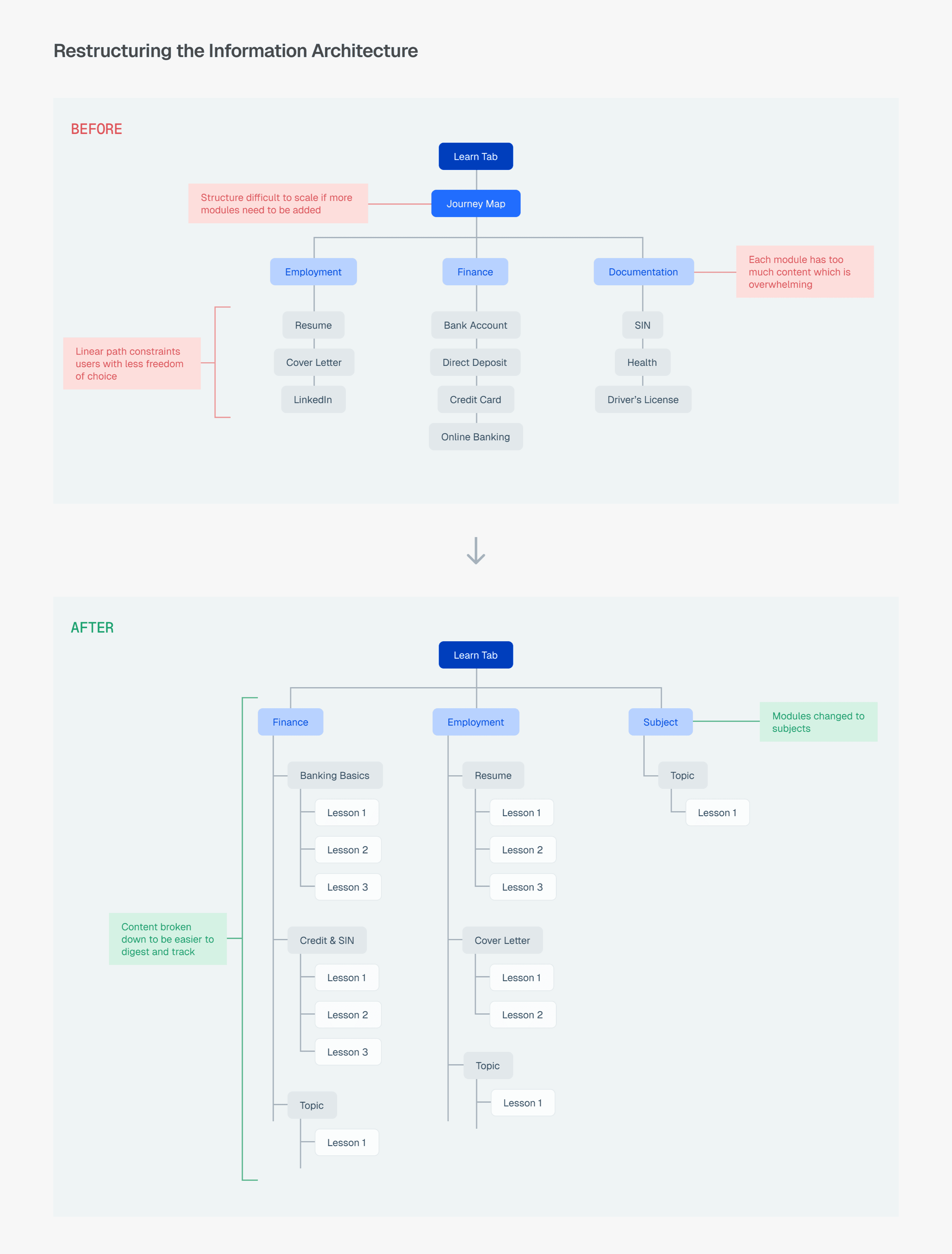
The exploratory map felt visually overwhelming, making it dense and difficult to interpret at a glance.
A strictly linear journey reduced flexibility, leading users to question whether they needed to complete every step, especially when they already had prior knowledge.
The structure does not allow for proper scaling, as adding more lessons risked crowding the map and making it harder to navigate.
Users preferred smaller, focused units, finding digestible lessons more approachable than large module groupings.
Where We Landed
We changed our approach to make it less like a formal course
To reduce cognitive load, we moved away from a centralized journey map. Instead, content was broken into smaller, digestible lessons, with progress tracked at the topic level rather than across the entire system.
Design Decisions
Subject → Topic → Lesson.
The journey map felt visually dense and difficult to scale as content grew. We restructured the information architecture into Subjects → Topics → Lessons, breaking complex systems into smaller, digestible units. This modular structure reduces cognitive load, supports flexible navigation, and scales without overwhelming users.
Topic level progress.
A centralized map made progress feel abstract and intimidating. We shifted to tracking progress at the topic level, allowing users to complete smaller, focused milestones. This makes progress clearer, more achievable, and easier to return to over time.
Resuming the last lesson.
Users often return after time away. We surfaced a “resume last lesson” shortcut to minimize friction and help users immediately continue where they left off.
Highlighting incomplete lessons.
Users need visibility into unfinished work. By clearly marking incomplete lessons within each topic, we reinforced progress awareness and encouraged completion without forcing a linear path.
Knowledge checks.
Mandatory assessments risked making the experience feel like a formal course. We introduced optional quick checks to reinforce understanding without blocking progress. This preserves psychological safety while supporting retention.
Integrating local events.
Information alone does not always translate into action. By embedding community events directly within the product, Unify connects digital learning with real-world support. This transforms the platform from static content into an active settlement ecosystem.
Reflection
What I Learned
The best product decisions happen when developers are involved early.
Designing alongside developers from the start helped surface constraints, clarify trade-offs, and reduce rework. Collaboration early on ensured ideas were not just desirable, but feasible.
Constraints don't limit ideas — they sharpen them.
Technical limits don't weaken ideas — they refine them. By grounding concepts in prototypes and clear examples, I learned to align ambition with implementation and deliver solutions that could realistically ship.